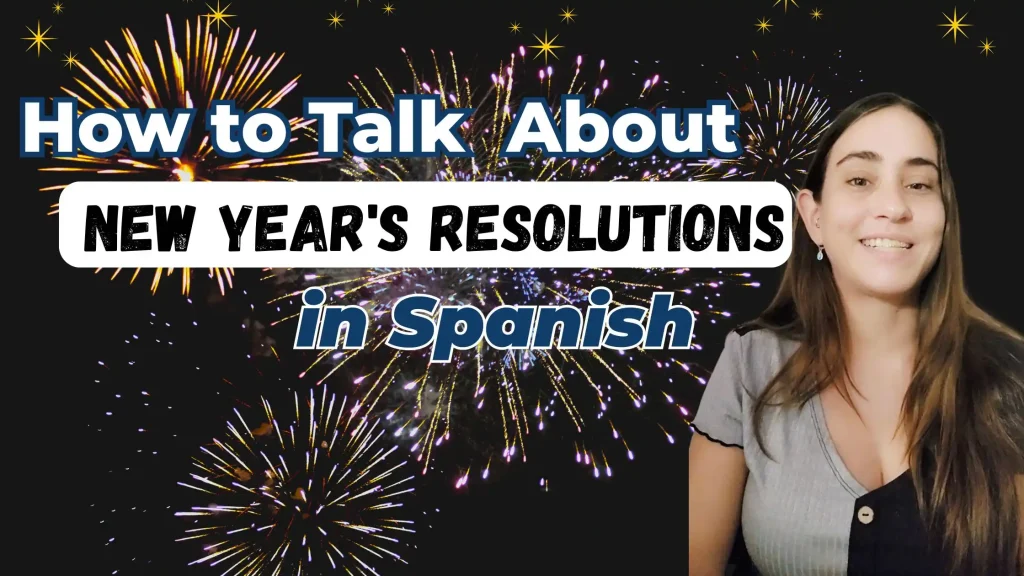
¡Feliz Año Nuevo! Start practicing the subjunctive today with three easy starter phrases to talk about New Year’s resolutions in Spanish. Check out the video to learn subjunctive starter phrases like espero que, quiero que, and ojalá in action and begin talking about your goals for this upcoming year today. ¡Espero que a ustedes les encante este video!
During this time of year, people reflect on their goals and set resolutions for personal growth. Talking about New Year’s resolutions in Spanish is a fun way to practice the language and incorporate the subjunctive mood. The subjunctive is often used to express hopes, wishes, and desires. This makes it perfect for discussing what you want to achieve in the coming year. In this blog, you’ll learn three common starter phrases that signal the subjunctive, which are: espero que, quiero que, and ojalá.
A Brief Review of Spanish Subjunctive Conjugations
The conjugations for the present tense in the subjunctive mood are actually pretty straightforward. If you’re familiar with command forms, you’ll find them quite easy to add to your knowledge base of Spanish. Remember to follow these three steps to get to the root of the verb in the present subjunctive:
| To form the present subjunctive root | Tener (to have) | Lograr (to achieve) | Seguir (to follow, to continue doing) |
| Go to the Yo | tengo | logro | sigo |
| Drop the “o” | teng | logr | sig |
| Add opposite endings AR – e / ER/IR – a | tenga | logre | siga |
Once you have your root of the verb with the opposite ending added, just follow these conjugation rules. Notice that the yo and él/ella/usted forms are the same.
| Yo | tenga | logre | siga |
| Tú | tengas | logres | sigan |
| Él/ella/usted | tenga | logre | siga |
| Nosotros | tengamos | logremos | sigamos |
| Ellos/ellas/ustedes | tengan | logren | sigan |
If you are familiar with command forms, particularly nosotros commands, then you should know the irregulars, stem-changers, and CAR, GAR, ZAR verbs. Check this nosotros commands blog to learn more. The same rules apply here to the present subjunctive.
Now that we’ve covered how to form the subjunctive, let’s move on to using it to express well-wishing and New Year’s resolutions in Spanish with the starter phrases: espero que, quiero que, and ojalá.
New Year’s Resolutions in Spanish: Espero que
The phrase Espero que means I hope that which is why it’s perfect to either talk about well wishing for others or for your own hopes for the coming year. Let’s see some examples using the subjunctive:
| Espero que mi familia y yo visitemos Machu Picchu en 2026. | I hope that my family and I visit Machu Picchu in 2026. |
| Espero que podamos comenzar un nuevo negocio este año. | I hope that we can start a new business this year. |
| Espero que tengas un año lleno de alegría y éxitos. | I hope that you have a year full of happiness and success. |
Without getting into the nitty gritty of the subjunctive mood, just know that any starter phrase that involves wishes or hopes will require the subjunctive in the second part of the sentence. Make sure the two subjects are different also; for example, I hope to visit Machu Picchu = espero visitar Machu Picchu, does not require the subjunctive because it consists of only one phrase (just like in English). Check out this blog to learn more subjunctive starter phrases.
New Year’s Resolutions in Spanish: Quiero que
Another great subjunctive starter phrase to express New Year’s resolutions in Spanish is using quiero que, which means I want someone/something to do an action. This is a great phrase for expressing what you would like for your loved ones to do. Let’s see some examples:
| Quiero que mi hijo aprenda a tocar un instrumento. | I want my son to learn to play an instrument. |
| Quiero que consigas un trabajo increíble este año. | I want you to get an awesome job this year. |
| Quiero que mis padres disfruten de unas buenas vacaciones en 2026. | I want my parents to enjoy a nice vacation in 2026. |
Do you want to learn more about the Spanish subjunctive? Check out CGI’s Spanish Lab: The Subjunctive where you can master using this unique mood in all of its tenses and all of its uses. This 4-part asynchronous course includes video lessons, PDF notes & exercises, practice tips and a feedback board. Check it out today!
Spanish New Year’s Resolutions: Ojalá
This final subjunctive starter used to express wishes or New Year’s resolutions in Spanish is ojalá. The word ojalá comes from Arabic, originally meaning “God willing,” due to the Moorish influence on Spanish history. Today, in everyday Spanish, it’s commonly used to express hope or a strong wish, similar to saying hopefully in English. Let’s see some examples below:
| Ojalá logre un mejor equilibrio entre mi trabajo y mi vida personal. | Hopefully I achieve a better work-life balance. |
| Ojalá el abuelo pase las vacaciones de verano con nosotros este año. | Hopefully, grandpa spends summer vacation with us this year. |
| Ojalá ahorremos suficiente dinero para remodelar la casa. | Hopefully we save enough money to remodel the house. |