Every minute counts during a stroke. For healthcare providers working with Spanish-speaking patients, knowing how to quickly identify and communicate stroke symptoms in Spanish can make the difference between a full recovery and permanent disability — or worse.
In this guide, you’ll learn the essential Spanish vocabulary for stroke symptoms, how to use the F.A.S.T. scale with Spanish-speaking patients, and how a real clinical conversation about stroke symptoms might unfold.
1. Key Vocabulary: Stroke Symptoms in Spanish
Before you can assess a patient, you need the right words. The table below covers the most critical stroke-related terms in Spanish — including both the formal/clinical term and the more colloquial expressions your patients are likely to use.
| English | Spanish (Formal / Clinical) | Colloquial / Common | Pronunciation |
|---|---|---|---|
| Stroke | accidente cerebrovascular (ACV) | derrame cerebral | ak-see-DEN-teh seh-reh-broh-bas-KU-lar |
| Brain hemorrhage / bleed | hemorragia cerebral | derrame en el cerebro | eh-moh-RAH-hyah seh-reh-BRAL |
| Slurred speech / slurring | balbuceo / disartria | hablar enredado / hablar chistoso | bal-boo-SEH-oh |
| Difficulty speaking | dificultad para hablar | no puede hablar bien | dee-fee-kool-TAD PAH-rah ah-BLAR |
| Mental confusion | confusión mental | estar confundido/a / no entender | kon-foo-SYON men-TAL |
| Severe headache | dolor de cabeza intenso | dolor de cabeza muy fuerte | doh-LOR deh kah-BEH-sah een-TEN-soh |
| Numbness / tingling | entumecimiento / adormecimiento | estar entumecido/a / hormigueo | en-too-meh-see-MYEN-toh |
| Dizziness | mareo | estar mareado/a | mah-REH-oh |
| Facial paralysis / drooping | parálisis facial | la cara caída / un lado de la cara caído | pah-RAH-lee-sees fah-SYAL |
| Loss of balance | pérdida de equilibrio | no poder caminar derecho | PER-dee-dah deh eh-kee-LEE-bryoh |
| Blurry / double vision | visión borrosa / visión doble | ver borroso / ver doble | bee-SYON boh-ROH-sah |
| Weakness | debilidad | estar débil / sin fuerza | deh-bee-lee-DAD |
| Arm weakness | debilidad en el brazo | el brazo no me responde | deh-bee-lee-DAD en el BRAH-soh |
| Sudden onset | de repente / de forma repentina | de un momento a otro | deh reh-PEN-teh |
| Loss of consciousness | pérdida de conciencia | desmayarse / perder el conocimiento | PER-dee-dah deh kon-SYEN-syah |
| High blood pressure | presión arterial alta / hipertensión | la presión alta | preh-SYON ar-teh-RYAL AL-tah |
| Blood clot | coágulo / trombo | coágulo de sangre | koh-AH-goo-loh |
💡 Important note: Many Spanish-speaking patients use derrame cerebral (literally “brain spill”) to refer to any stroke, whether ischemic or hemorrhagic. In clinical settings, use accidente cerebrovascular (ACV) — but recognize derrame when patients say it, as they mean the same thing.
2. The F.A.S.T. Scale in Spanish
The F.A.S.T. acronym is the universal tool for recognizing stroke symptoms quickly. In Spanish, it translates to R.Á.P.I.D.O. — though many bilingual health campaigns also use F.A.S.T. directly with Spanish explanations. Here’s both:
F.A.S.T. — With Spanish Explanations
F — Face (Cara) ¿Tiene la cara caída de un lado? – Is one side of the face drooping?
Pida al paciente que sonría. ¿La sonrisa es asimétrica? – Ask the patient to smile. Is the smile uneven?
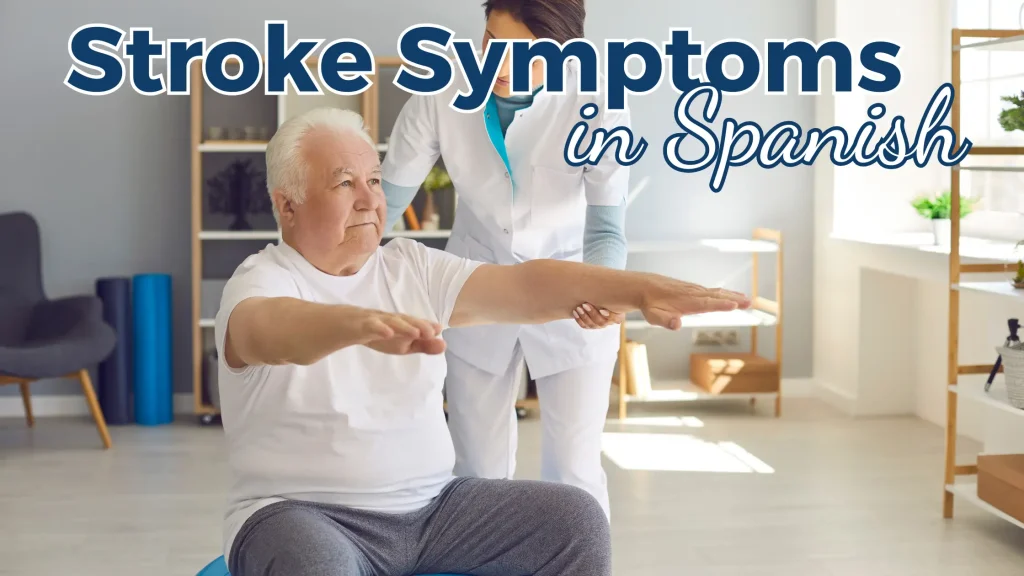
A — Arms (Brazos) ¿Puede levantar ambos brazos? ¿Uno cae hacia abajo? – Can they raise both arms? Does one drift downward?
Pida al paciente que levante los dos brazos. ¿Uno baja solo? – Ask the patient to raise both arms. Does one fall on its own?
S — Speech (Habla) ¿Tiene dificultad para hablar? ¿Habla enredado o no puede hablar? – Do they have difficulty speaking? Is speech slurred or absent?
Pida al paciente que repita una frase simple. ¿Puede hacerlo con claridad? – Ask the patient to repeat a simple phrase. Can they do it clearly?
T — Time (Tiempo) Si nota alguno de estos síntomas, llame al 911 inmediatamente. – If you notice any of these symptoms, call 911 immediately.
El tiempo es cerebro. Cada minuto cuenta. – Time is brain. Every minute counts.
R.Á.P.I.D.O. — The Spanish Acronym
Some Spanish-language stroke awareness campaigns use R.Á.P.I.D.O. as the equivalent:
| Letter | Spanish | Meaning |
|---|---|---|
| R | Rostro caído | Face drooping |
| Á | Ángulo del brazo | Arm weakness |
| P | Problemas para hablar | Speech difficulty |
| I | Intenso dolor de cabeza | Intense headache |
| D | Dificultad para ver | Vision difficulty |
| O | Obtener ayuda de emergencia / llamar al 911 | Call for emergency help |
💡 Tip: Whether you use F.A.S.T. or R.Á.P.I.D.O., what matters most is speed. Teach patients and families both versions so they recognize stroke warnings and act immediately.
3. Asking About Stroke Symptoms: Patient Questions
These are the key questions to ask when assessing a patient for possible stroke. Use the formal usted form with adult patients.
Onset & Timing
- ¿Cuándo comenzaron los síntomas? – When did the symptoms begin?
- ¿Los síntomas comenzaron de repente o gradualmente? – Did the symptoms start suddenly or gradually?
- ¿Qué estaba haciendo cuando comenzaron los síntomas? – What were you doing when the symptoms started?
Face & Vision
- ¿Ha notado que un lado de su cara está caído o diferente? – Have you noticed that one side of your face is drooping or looks different?
- ¿Tiene la boca torcida o asimétrica? – Is your mouth twisted or uneven?
- ¿Está viendo doble o borroso? – Are you seeing double or is your vision blurry?
- ¿Ha perdido la visión en un ojo o en los dos? – Have you lost vision in one or both eyes?
Arms, Legs & Balance
- ¿Siente debilidad o entumecimiento en un brazo o una pierna? – Do you feel weakness or numbness in an arm or leg?
- ¿Puede levantar ambos brazos? – Can you raise both arms?
- ¿Ha tenido dificultad para caminar o para mantener el equilibrio? – Have you had difficulty walking or keeping your balance?
- ¿Se ha caído recientemente? – Have you fallen recently?
Speech & Thinking
- ¿Ha tenido dificultad para hablar o para encontrar las palabras? – Have you had difficulty speaking or finding words?
- ¿Alguien le ha dicho que está hablando enredado? – Has anyone told you that your speech sounds slurred?
- ¿Tiene dificultad para entender lo que le dicen? – Are you having difficulty understanding what people say to you?
- ¿Se siente confundido/a o desorientado/a? – Do you feel confused or disoriented?
Head & Other Symptoms
- ¿Tiene dolor de cabeza? ¿Es el peor dolor de cabeza que ha tenido en su vida? – Do you have a headache? Is it the worst headache of your life?
- ¿Tiene mareos o sensación de que todo da vueltas? – Do you have dizziness or a sensation that everything is spinning?
- ¿Ha tenido náuseas o ha vomitado? – Have you had nausea or vomited?
4. Sample Doctor–Patient Dialogues
Dialogue 1: Initial Stroke Assessment in the Emergency Room
Doctor: Buenos días. Soy el doctor Ramírez. ¿Cómo se llama usted? – Good morning. I’m Dr. Ramírez. What is your name?
Patient: Me… me llamo… Carlos. – My… my name is… Carlos.
Doctor: Carlos, ¿puede decirme qué pasó? ¿Cuándo comenzaron los síntomas? – Carlos, can you tell me what happened? When did your symptoms start?
Patient: Hace como… una hora. De repente me cayó la cara y no podía hablar bien. – About… an hour ago. Suddenly my face drooped and I couldn’t speak well.
Doctor: Entiendo. ¿Sintió debilidad en algún brazo o pierna? – I understand. Did you feel weakness in any arm or leg?
Patient: Sí, el brazo derecho. No lo podía levantar. – Yes, my right arm. I couldn’t lift it.
Doctor: ¿Tuvo dolor de cabeza? ¿Muy intenso? – Did you have a headache? Very intense?
Patient: No, no me dolió la cabeza. Solo la cara y el brazo. – No, my head didn’t hurt. Just my face and arm.
Doctor: Bien, Carlos. Voy a hacerle unas pruebas para ver qué está pasando en su cerebro. Es muy importante que no se mueva. ¿Me entiende? – Good, Carlos. I’m going to run some tests to see what’s happening in your brain. It’s very important that you don’t move. Do you understand me?
Patient: Sí, doctor. Entiendo. – Yes, doctor. I understand.
Dialogue 2: Family Member Reporting Symptoms
Doctor: ¿Usted es familiar del paciente? – Are you a family member of the patient?
Family member: Sí, soy su esposa. Llegué a casa y lo encontré sentado, muy confundido, y tenía la cara caída de un lado. – Yes, I’m his wife. I came home and found him sitting down, very confused, and one side of his face was drooping.
Doctor: ¿A qué hora lo encontró así? – What time did you find him like that?
Family member: Hace como dos horas, pero no sé cuánto tiempo llevaba así. – About two hours ago, but I don’t know how long he had been like that.
Doctor: ¿Estaba hablando enredado o no podía hablar? – Was he speaking slurred or could he not speak?
Family member: Hablaba muy raro, como enredado, y no entendía lo que yo le decía. – He was speaking very strangely, like slurred, and he didn’t understand what I was saying to him.
Doctor: ¿Pudo caminar o se caía? – Was he able to walk or was he falling?
Family member: Intentó pararse y casi se cae. Dijo que todo le daba vueltas. – He tried to stand up and almost fell. He said everything was spinning.
Doctor: Hizo bien en llamar al 911 de inmediato. Cada minuto es muy importante en estos casos. Vamos a atenderlo de urgencia. – You did the right thing by calling 911 immediately. Every minute is very important in these cases. We are going to treat him urgently.
5. Tips for Communicating Clearly in Stroke Emergencies
Speak slowly and use simple sentences In a stroke emergency, patients may have difficulty processing language. Use short, direct sentences: “No se mueva.” (Don’t move.) “Voy a ayudarle.” (I’m going to help you.) Avoid complex explanations until the patient is stable.
Test speech, arms, and face quickly Three rapid commands tell you a lot:
- “Sonría, por favor.” — Smile, please. (tests facial symmetry)
- “Levante los dos brazos.” — Raise both arms. (tests arm drift)
- “Repita esto: El cielo es azul.” — Repeat this: The sky is blue. (tests speech clarity)
Ask the family — not just the patient Stroke patients often can’t accurately report their own symptoms due to confusion or aphasia. Always ask a family member or bystander: “¿Cuándo comenzaron los síntomas?” (When did the symptoms start?) and “¿Cómo estaba antes de esto?” (How was he/she before this?)
Know the “last known well” concept in Spanish The critical question in stroke care is when the patient was last seen normal. In Spanish: “¿Cuándo fue la última vez que lo/la vio bien?” (When was the last time you saw him/her acting normally?) This determines treatment eligibility.
Use derrame cerebral if the patient doesn’t understand ACV Don’t let vocabulary be a barrier. If a patient looks confused when you say accidente cerebrovascular, switch to derrame cerebral — most Spanish speakers will recognize it immediately.
⚠️ False cognate alert: Sensible in Spanish means sensitive, not sensible. If you want to say a patient is making sense or is alert, use consciente (conscious/aware) or orientado/a (oriented), not sensible.
6. Summary
Stroke is a medical emergency where language barriers can cost lives. With this vocabulary and these clinical phrases, you’re better prepared to quickly assess Spanish-speaking patients, communicate urgency to families, and coordinate care in critical moments.
Want to keep building your medical Spanish? Check out our related guides on Medical Spanish series.