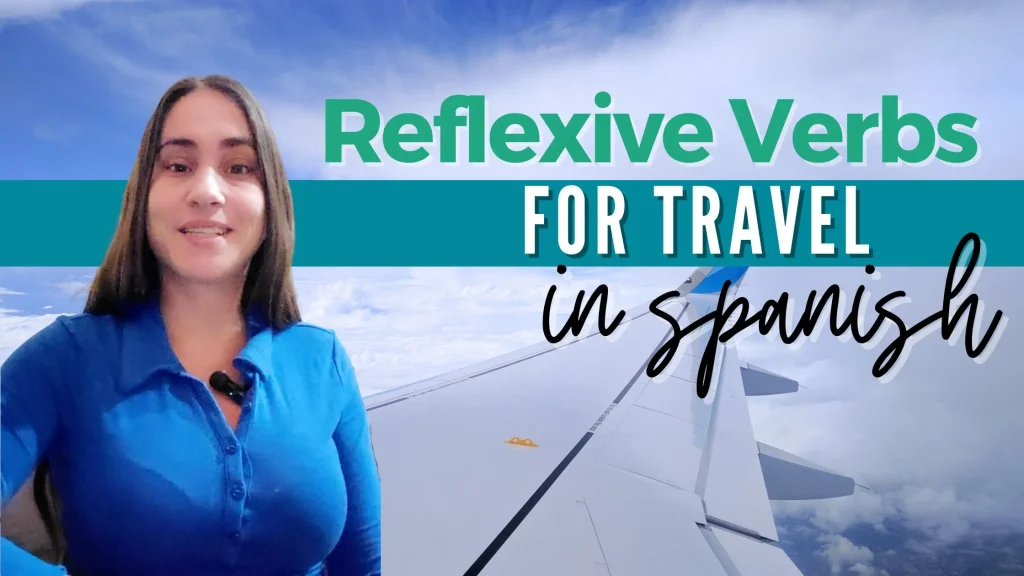
When you learn Spanish abroad, the language becomes real from the very first day. Instead of only studying grammar in a classroom, you use it everyday. One of the most important grammar areas you will use daily during an immersion program is reflexive verbs in Spanish. Watch the short video lesson below to see how to use Spanish reflexive verbs for travelers in action.
Verbs like irse, quedarse, perderse, divertirse, and bajarse are part of the core travel Spanish vocabulary every student needs when they learn Spanish abroad. These reflexive verbs help you talk about movement, location, and everyday situations that naturally happen during Spanish immersion travel. As you grow more confident, verbs such as darse cuenta and imaginarse allow you to express realization and assumptions in a more natural and fluent way.
At Common Ground International, we offer immersive programs in Costa Rica, Ecuador, Chile & Argentina designed to help you learn Spanish abroad through real experience. Students take intensive Spanish classes, engage with local communities, and participate in meaningful cultural activities that build fluency and confidence. Whether you are an adult learner, a teen, a teacher, or a healthcare professional, our Spanish immersion programs combine language study with authentic travel and service learning for lasting impact. Check them out here.
Learn Spanish Abroad Using Reflexive Verbs for Travel
Reflexive verbs in Spanish are often introduced through daily routines such as despertarse or vestirse, which is why many students associate them only with daily routines. However, reflexive verbs also describe movement and emotions, which is why several of them are used often when you travel.
To use a reflexive verb, you include a reflexive pronoun that matches the subject of the sentence. The pronoun comes before the conjugated verb in most tenses. Some reflexive verbs, like divertirse and perderse, are also stem changing in certain forms, which means their vowel changes when conjugated. Knowing reflexive verbs is a must to describe routines, movement, and emotions more naturally in Spanish.
Let’s see how to conjugate reflexive AR, ER, and IR verbs in the table below:
| Quedarse | Perderse (e-ie) | Divertirse (e-ie) |
| Me quedo | Me pierdo | Me divierto |
| Te quedas | Te pierdes | Te diviertes |
| Se queda | Se pierde | Se divierte |
| Nos quedamos | Nos perdemos | Nos divertimos |
| Se quedan | Se pierden | Se divierten |
Need a refresher on reflexive verbs? Check this blog here.
Quedarse
Quedarse means to stay in Spanish. It is a useful reflexive verb when you learn Spanish abroad because you can use it to talk about where you are staying, how long you remain in a place, or whether you decide to stay somewhere longer.
| Nos quedamos en un Airbnb cerca de la playa. | We stay at an Airbnb near the beach. |
| Nuestros estudiantes se quedan con familias anfitrionas. | Our students stay with host families. |
Perderse
Perderse means to get lost in Spanish. It is a common reflexive verb you use when you talk about not knowing where you are or how to get somewhere. When you learn Spanish abroad, sometimes you do not always have cell service, so you still might get lost!
| Nos perdimos buscando el restaurante. | We got lost looking for a restaurant. |
| Siempre me pierdo fácilmente en ciudades grandes. | I always get lost easily in big cities. |
Divertirse
Divertirse means to have fun in Spanish. You use this reflexive verb often when you learn Spanish abroad to describe enjoying your time or experiences in a new place.
| Nos divertimos mucho en la excursión. | We had fun on the tour. |
| ¿Te divertiste en el tour del volcán? | Did you have fun in the volcano excursion? |
Bajarse
Bajarse means to get off in Spanish. You commonly use this reflexive verb when learning Spanish abroad to talk about getting off a bus, train, or other form of transportation.
Darse Cuenta
Darse cuenta means to realize or to notice in Spanish. You use this verb when learning Spanish abroad to talk about becoming aware of something, such as noticing a mistake, realizing a schedule change, or recognizing new information. It is important not to confuse it with realizar, which is a false cognate. Although realizar looks like the English verb realize, it actually means to carry out, to accomplish, or to perform, not to become aware of something.
Imaginarse
Imaginarse means to imagine or to suppose in Spanish. When you learn Spanish abroad, you will often use this reflexive verb to make assumptions or express possibilities. It is also useful for reacting to new situations or picturing what an experience might be like.