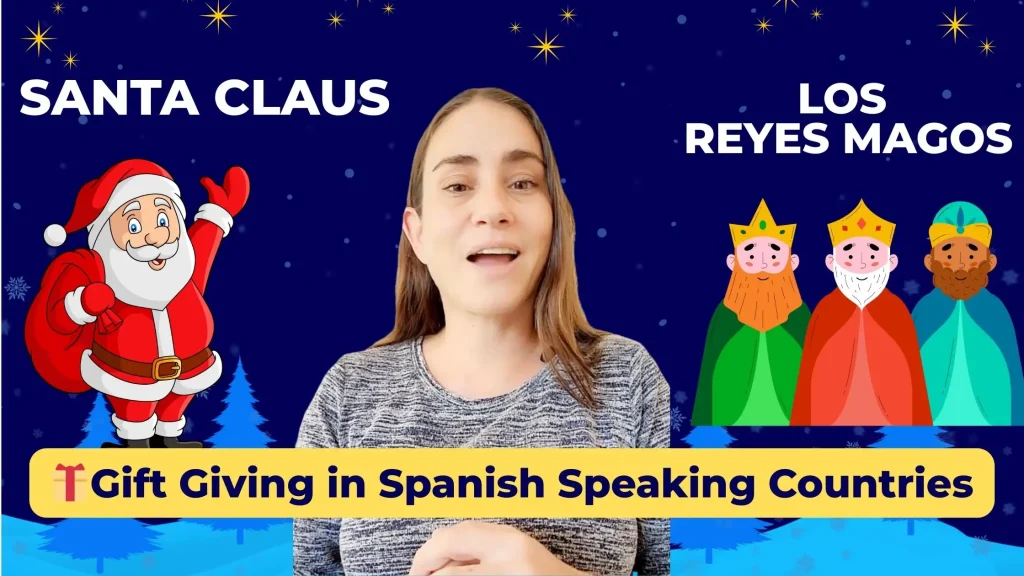
Who brings the gifts to the children in Spanish-speaking Countries? ¿Quién les trae los regalos? When it comes to Christmas traditions, not every country celebrates the same way, or even with the same gift-giver. Check the video lesson below about Christmas gift-giving in Latin America and Spain!
Christmas gift-giving in Spanish-speaking countries is as diverse as the celebrations that encompass the Fiestas Navideñas. Across Latin America and Spain, children often grow up believing in Los Reyes Magos or The Three Wise Men, rather than Santa Claus. While Santa is more visible today due to globalization and media, Reyes Magos remains deeply rooted in history, religion, and culture.
Christmas Gift-Giving in Spanish: Who Are the Reyes Magos?
Los Reyes Magos, Melchor, Gaspar, and Baltasar, come from the biblical story of the Three Wise Men who followed a star to visit Baby Jesus. In Spain and many Latin American countries, children receive gifts on January 6th, known as Día de los Reyes instead of, or in addition to, Christmas gift-giving. On the night of January 5th, children often leave out shoes, water, or treats for the camels. The next morning, they wake up to presents.
In Spain, the celebration includes large public parades called Cabalgatas de Reyes, where the Three Kings throw candy to crowds. In many Spanish-speaking countries, Reyes Magos is a major holiday. It celebrates family gatherings, gifts, and food. The Rosca de Reyes is one special dessert, usually a sweet bread or cake. Among devout Catholics, January 6th is a religious holiday. As a result, families often attend misa or mass. Finally, this day generally represents an end to the festive season in the Spanish-speaking world.
What Does “Magos” Mean in Spanish?
In ancient times, the word magos referred to wise men or scholars, especially people who studied the stars. They were advisors and astrologers, not wizards or fantasy magicians. The Reyes Magos followed the Star of Bethlehem because they observed the sky, not because they used magic.
Santa Claus: a Growing Spanish Gift-Giving Tradition
Santa Claus (Papá Noel) has become more common across Latin America and Spain, especially in urban areas. This is thanks to the influence of US culture from movies, TV and the internet. In these households, children may receive gifts on December 24th or 25th from Santa. Additionally, they may also receive gifts from Los Reyes Magos too! In this sense, rather than replacing traditional customs, Santa often exists alongside them.
Interestingly, when children receive gifts on Christmas Eve or Nochebuena, their parents or other adults distract them, so that Papá Noel can enter the home and leave their presents under the Christmas tree. Remember, in most of the Spanish-speaking world, Nochebuena is the big celebration, not Navidad or Christmas day.
El Niño Jesús: Another Gift-Giver in the Spanish World
In some parts of the Spanish-speaking world, especially amongst religious households, children may receive gifts from El Niño Jesús or the Baby Jesus rather than Santa Claus on the 24th or 25th. El Niño Jesús is seen as a gentle, spiritual figure who rewards good behavior and reminds families of the true meaning of Christmas. Even amongst families with more secular traditions, El Pesebre or the nativity scene is an essential part of the Christmas tradition. It’s common to see nativity scenes set up, big or small, in or around homes, malls, and central parks in December.
Is Gift-Giving an Essential Part of Christmas Traditions in the Spanish-Speaking World?
In North America, gift-giving is certainly an essential part of the Christmas tradition. However, in many families across Latin America, the essence of Navidad is the time spent together in family. Many households opt out of gift-giving altogether. However, in some traditions, like this author’s Nicaraguan-side of the family, presents are exchanged or given to the children by their immediate family members. Ultimately, whether gifts are exchanged or not, the heart of Navidad lies in celebrating family, tradition, and togetherness.